Getting Started in Cities at War
Join the server, stand up a working economy, then take your first map objective before rivals snowball.
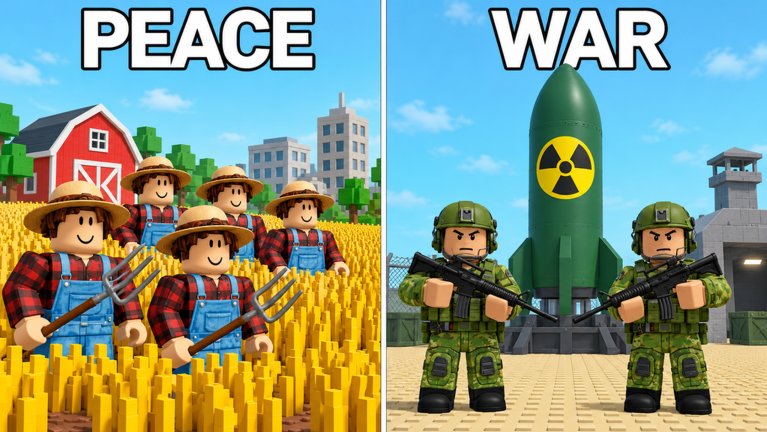
Cities at War is a Roblox simulation tycoon from Snick Co. / SnickTrix where up to six players build cities, trade at docks, research upgrades, and fight over map objectives. Your first session should not be about fancy jets. It should be about cash flow, workers, builder capacity, and a clear capture target. This guide walks that opening loop so you leave the tutorial phase with a city that earns while you are away and an army that can contest early outposts.
If you want promo rewards before you spend, check Codes first. For unit rankings later, use the Tier List. The rest of this page is the day-one checklist.
Join the game and read the map
Open Cities at War on Roblox, join a server with free city slots, and spawn into your starting plot. Take thirty seconds to orient: where your buildable land sits, where the trade docks are, and which neutral objectives sit between you and the Capital at map center. Servers hold a small player count, so every neighbor is a future rival. Note who already has walls, barracks, or captured markers nearby. You do not need a full war plan yet, but you do need to know whether someone is already racing outposts.
Claim any starter prompts or UI tips the game shows. Then ignore shiny late-game buildings until your food, materials, and housing loop is alive. Early overspending on prestige structures is the most common beginner wipe.
Bootstrap farms and basic production
Your first money comes from production buildings. Place farms early so food and trade goods start ticking. Add mines and mills when you can afford them so you are not selling a single commodity into a soft dock market. Diversity matters because dock prices change every few minutes. If you only grow one good and that price dips, your session income stalls.
Keep production compact near your core so workers and builders waste less travel time. Leave lanes for future barracks and defense. A messy early sprawl looks busy but slows every upgrade that follows. For layout patterns that scale into mid game, see Base Layout.
Houses, workers, and builder huts
Production without people is dead weight. Build homes so your workforce can grow, then place builder huts so construction queues do not sit idle. Homes and builder capacity are the quiet multipliers behind every farm, mill, barracks, and tower you want next. If you keep placing industry while houses and builder huts lag, you create a city that looks rich on paper and moves like sludge.
Prioritize enough housing to keep workers employed, then enough builder huts to finish the next two or three planned buildings without long waits. When you leave the game, offline earnings reward cities that were already producing. A half-built sprawl with empty plots earns less than a tight loop of finished farms, homes, and docks access.
Sell goods at the docks
Once goods are flowing, use the trade docks. Prices refresh on a short timer, so treat selling as an active habit rather than a one-click dump. Sell when your main goods are high, hold a little inventory when they are low, and avoid panic-selling everything the moment you need one building. Cash spikes from good dock timing fund barracks and research much faster than idle stockpiles.
Early money priorities are simple: finish the production loop, keep builders busy, unlock research that speeds income or build rate, then bank a buffer for your first military push. Deep dock timing and offline income strategy live in the Economy and Docks guide.
Early barracks and a minimum defense
You do not need a full air wing in hour one, but you do need a barracks and a small standing force before you wander toward contested markers. Place barracks where units can exit toward the map without pathing through your entire farm grid. Add a sniper tower or two covering approach lanes once cash allows. Early defense is about not losing your core to a rush while you are still learning placement tools.
Train a mix that can hold ground and screen for captures. Soldiers form the backbone; unlock tanks, helicopters, jets, and drones as your economy and research catch up. For unit roles and expansion order, read Army Build. Pair military spending with Research Tree picks that raise army strength instead of dumping cash into vanity buildings.
First capture goal
Cities at War is not only a tycoon. The map ladder runs from outposts to firebases to oil rigs to the Capital, then into attacks on rival cities. Your first capture goal should be a nearby outpost you can take and hold, not a glamorous mid-map fight you cannot reinforce. Capture income and map pressure matter more than a pretty skyline.
Before you march, confirm you can replace losses and still keep farms running. A capture that empties your treasury and leaves homes undefended is a gift to the next player who notices. Full capture order, Capital timing, and PvP notes are in Capture Points. Scout rival activity on the Players hub when you want server meta context.
Research without stalling the city
Open the skill or research tree as soon as it is available. Early points usually pay best in income, build speed, or army strength—whichever bottleneck you feel first. If builders are idle and cash is fine, push build speed. If cash is the wall, push income. If you are about to contest an outpost, lean army strength. Do not spread points so thin that nothing moves the needle. Priority frameworks are covered in Research Tree.
First-session checklist
- Join a server and locate docks, neighbors, and the Capital direction.
- Place starter farms, then mines or mills for trade diversity.
- Add homes and builder huts so production and construction keep moving.
- Sell at docks on favorable price ticks; keep a cash buffer.
- Build barracks, train a small force, and drop light defensive towers.
- Research one clear bottleneck: income, build speed, or army strength.
- Capture a nearby outpost you can actually hold.
- Reinvest capture gains into production and the next military tier.
What to open next
After this page, deepen money play in Economy and Docks, army composition in Army Build, map progression in Capture Points, upgrade order in Research Tree, and placement habits in Base Layout. Controls and UI notes live in Controls. Claim any live rewards on Codes, then compare units on the Tier List before your first serious push.
Play the opening patiently. Cities at War rewards cities that earn offline, trade on timing, and capture with purpose. If your first hour ends with finished production, busy builders, a barracks, and one held outpost, you are ahead of players who spent the same time decorating empty plots.
For soft rankings, open the Units Tier List and Buildings Tier List.
Frequently Asked Questions
Quick answers for Cities at War on Roblox.
What should I build first in Cities at War?
Start with farms and basic production, then homes and builder huts so workers and construction keep pace. Sell goods at the docks before heavy military spending.
When should I build barracks as a beginner?
After your production and housing loop is online and you have a cash buffer. A small barracks force protects your core and enables a first outpost capture.
Do I earn money while offline?
Yes. Finished production and a working city continue earning while you are away, so prioritize complete loops over half-built sprawl before you log off.
What is the first capture I should take?
A nearby outpost you can reinforce. Save firebases, oil rigs, and the Capital until your army and income can support longer fights.
Should I unlock jets and drones in the first session?
Usually no. Secure farms, docks income, barracks infantry or early vehicles, and research that fixes your bottleneck before expensive air units.
Where do codes and unit rankings fit for new players?
Redeem anything active on the Codes page for a free boost, then use the Tier List when you are ready to specialize army composition beyond the starter mix.